Post-Approval Compliance Monitoring (PACM)
Post-Approval Compliance Monitoring (PACM) is part of Florida State University's Office for Human Subjects Protection (OHSP) and the IRB's ongoing oversight of approved human subjects research. PACM supports study teams throughout the life of a study by providing structured monitoring activities that help ensure compliance with IRB-approved protocols and applicable regulatory and institutional requirements.
PACM consists of two complementary components: PACM Oversight, the core study monitoring function, and PACM Engagement and Check-Ins, a supportive layer that provides education, communication, and ongoing compliance support. Together, these activities provide both formal oversight and collaborative support throughout the conduct of a study.
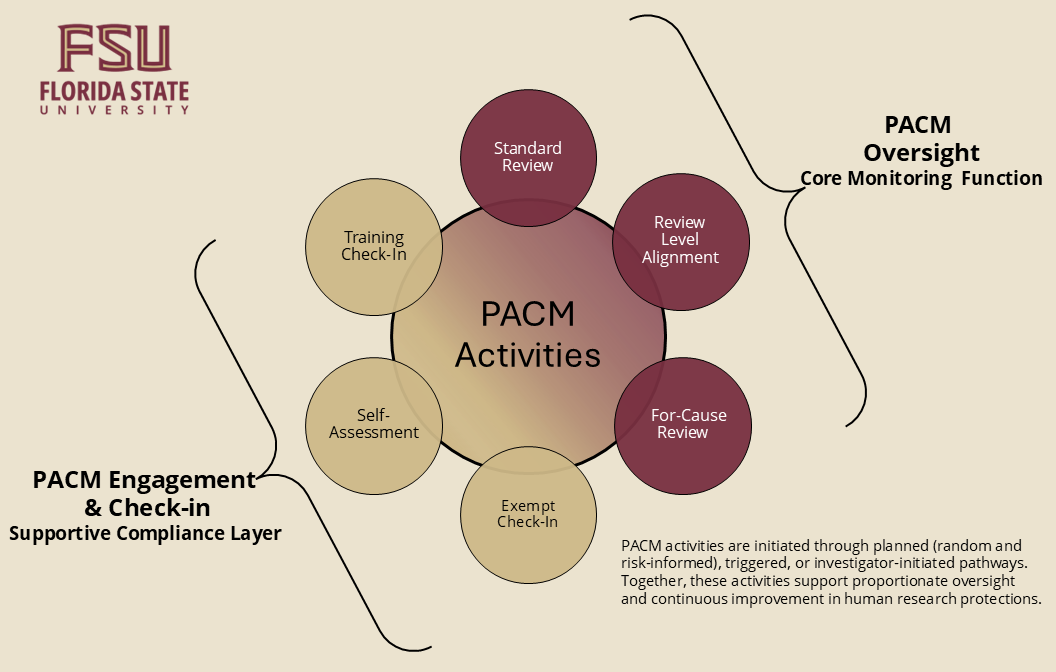
PACM Activities
PACM activities include routine monitoring and targeted reviews. Most PACM activities are routine and do not indicate a concern with a study. Certain activities, such as For-Cause Reviews, are initiated in response to specific concerns or reported events that warrant additional review.
Standard Review
- Purpose: Routine oversight of approved expedited and full board studies
- Basis for Review: Planned (random, risk/complexity informed per PACM selection criteria)
- Engagement Model: Collaborative OHSP & Study Team
- Study Team Involvement: Active engagement based on scope
- Scope: Study activities (consent, recruitment procedures, data management etc); may be focused or comprehensive
Review Level Alignment
- Purpose: Confirmation of alignment of the IRB review level with the current study activities
- Basis for Review: Planned (random, risk/complexity informed per PACM selection criteria)
- Engagement Model: OHSP-directed structured response
- Study Team Involvement: Clarification; brief response/insight
- Scope: IRB review classification and current study conduct
For-Cause Review
- Purpose: Investigation of potential or reported non-compliance or harm to participants
- Basis for Review: Triggered (complaints, deviations, external reports, or concerns)
- Engagement Model: Collaborative OHSP & Study Team
- Study Team Involvement: Active engagement
- Scope: Specific issues or areas of concern; may expand in scope depending on findings or emerging information
Exempt Check-In
- Purpose: Brief touchpoint of exempt studies on progress and ethical practices
- Basis for Review: Planned (random, risk/complexity informed per PACM selection criteria)
- Engagement Model: OHSP-directed structured response
- Study Team Involvement: Brief informational response via checklist
- Scope: Exempt study status and progress updates; may be brief or expanded based on study updates or input by PI
Training Check-In
- Purpose: Verification of training and role compliance
- Basis for Review: Planned (random)
- Engagement Model: OHSP-directed structured response
- Study Team Involvement: Brief informational response via checklist
- Scope: CITI training status and role assignments of study personnel; may included PI-identified training gaps
Self-Assessment
- Purpose: PI-led review of study compliance and PACM tools
- Basis for Review: Voluntary (PI-initiated with PACM support requested)
- Engagement Model: Study team-led engagement
- Study Team Involvement: Owned by study team; optional worksheet
- Scope: Study activities as determined by PI using PACM tools; may be submitted for feedback or support
PACM Process and Expectations
The PACM process varies depending on type and purpose of the activity. Study teams may be asked to provide study records, respond to questions, or participate in discussions and/or structured interviews with OHSP. PACM activities are intended to support compliance, identify areas of improvement, and promote ongoing to IRB and institutional requirements.
PACM activities are selected using defined selection criteria applied through two mechanisms: (1) risk/complexity-informed random sampling conducted at defined intervals, and (2) event-driven triggers, such as reported concerns, protocol deviations, external inquiries, or requests from the Principal Investigator.
Together, these approaches support broad and equitable oversight across the research portfolio while allowing for proactive, targeted review based on study complexity, participant risk, and evolving conditions. Selection criteria are designed to minimize burden on Principal Investigators, generally avoiding review of multiple studies under the same Principal Investigator within a 12-month period unless warranted by specific circumstances, such as new information or elevated risk.
PACM activities vary in the level and type of engagement between OHSP and the study team. Some activities are OHSP-directed with study team support, others are collaborative in nature with active participation from both OHSP and study team, and some are PI-led with OHSP involvement available as needed. Across all activities, engagement is designed to be proportionate to the scope and purpose of the review or check-in, and processes are designed to be transparent, clearly communicated, and minimally disruptive to ongoing research.
While specific steps vary by activity type, the general process follows a consistent structure:
- Notification of selection or initiation of a PACM activity, including the type of activity and study or protocol(s) involved
- Clear instructions on what to prepare or provide, including any applicable checklists, documentation requests, or response forms
- Defined timelines for response and review, which vary based on the type of PACM activity
- Ongoing communication throughout the process, including clarification requests or check-ins as needed
- A summary of findings or outcome, which may include confirmation of compliance, recommendations, or required follow-up actions
- When follow-up is required, the PI works with OHSP to address identified findings and complete any required corrective actions, which may include development of a Corrective and Preventive Action (CAPA) plan or other actions as appropriate
- Findings and follow-up actions may be shared with the IRB and other institutional offices as appropriate, particularly when required for reporting, oversight, or review of elevated concerns.
PACM outcomes are intended to support research teams in maintaining compliance, strengthening study practices, and addressing any issues that require follow-up. Outcomes vary based on the type of PACM activity, the scope of the review, and observations identified. Multiple outcomes may apply within a single PACM activity, depending on the circumstances.
Review Outcomes
- No findings
Study activities and documentation align with the IRB-approved protocol and applicable requirements. No further action is needed.
- Recommendations and best practices
Minor opportunities for improvement are identified (e.g., documentation updates or process clarifications). Recommendations are shared with the research team; a formal response is not typically required.
- Minor findings
Limited deficiencies are identified that require correction. The PI provides a response outlining the planned corrective actions and timeline for resolution, as applicable. OHSP may provide guidance as needed and verifies that corrective actions are implemented.
- Reportable findings
More significant concerns may require formal reporting to the IRB. The PI submits a Reportable New Information (RNI) submission in RAMP IRB. The IRB review process of the RNI determines required corrective actions and next steps.
Follow-Up Actions
- Follow-up or continued monitoring
In some cases, additional engagement or monitoring may be conducted to support resolution of findings or to confirm sustained compliance.
- Corrective Action Plan Required
- Referral to other offices (if applicable)
If identified concerns fall outside the scope of PACM oversight (e.g., research integrity, misconduct, or biosafety), OHSP coordinates with the appropriate institutional offices.
Report of New Information (RNI): How Does an RNI Fit Into PACM?
Reporting new information is an important part of ongoing post-approval compliance. Research teams are responsible for bringing certain events, concerns, or other new information to the IRB when required.
A Report of New Information (RNI) is the formal report submitted to the IRB. RNI reporting can occur at any point during a study and does not depend on whether a study has been selected for any of the PACM activities.
RNI Reporting and PACM activities can also inform one another. An RNI may result in a PACM activity when additional monitoring or review is appropriate. Likewise, information identified during a PACM activity may result in an RNI when the circumstances require reporting to the IRB. In this way, RNI reporting and PACM work together as part of ongoing post-approval oversight.
The RNI form includes the following reporting categories. Depending on the circumstances, more than one category may apply. If information arising during your study falls into any of the following categories, you should submit an RNI to the IRB.
- Risk
Information that indicates a new or increased risk, or a safety issue. For example:
- New information (e.g., an interim analysis, safety monitoring report, publication in the literature, sponsor report, or investigator finding) indicates an increase in the frequency or magnitude of a previously known risk, or uncovers a new risk.
- An investigator brochure, package insert, or device labeling is revised to indicate an increase in the frequency or magnitude of a previously known risk, or to describe a new risk.
- Withdrawal, restriction, or modification of a marketed approval of a drug, device, or biologic used in a research protocol.
- Protocol violation that harmed subjects or others or that indicates subjects or others might be at increased risk of harm.
- Complaint of a subject that indicates subjects or others might be at increased risk of harm or at risk of a new harm.
- Any changes significantly affecting the conduct of the research.
- Harm
Any harm experienced by a subject or other individual that, in the opinion of the investigator, is unexpected and at least probably related to the research procedures.
- A harm is “unexpected” when its specificity or severity is inconsistent with risk information previously reviewed and approved by the IRB in terms of nature, severity, frequency, and characteristics of the study population.
- A harm is “probably related” to the research procedures if, in the opinion of the investigator, the research procedures more likely than not caused the harm.
- Non-Compliance
Non-compliance with the federal regulations governing human research or with the requirements or determinations of the IRB, or an allegation of such non-compliance.
- Audit
Audit, inspection, or inquiry by a federal agency.
- Report
Written reports of study monitors.
- Researcher Error
Failure to follow the protocol due to the action or inaction of the investigator or research staff.
- Confidentiality
Breach of confidentiality.
- Unreviewed Change
Change to the protocol taken without prior IRB review to eliminate an apparent immediate hazard to a subject.
- Incarceration
Incarceration of a subject in a study not approved by the IRB to involve prisoners.
- Complaint
Complaint of a subject that cannot be resolved by the research team.
- Suspension
Premature suspension or termination of the research by sponsor, investigator, or institution
- Unanticipated Adverse Device Effect
Any serious adverse effect on health or safety or any life-threatening problem or death caused by, or associated with, a device, if that effect, problem, or death was not previously identified in nature, severity, or degree of incidence in the investigational plan or application (including a supplementary plan or application), or any other unanticipated serious problem associated with a device that relates to the rights, safety, or welfare of subjects.
 PACM Support and Resources PACM Support and Resources
Tools and Templates
Coming soon!
Post Approval Consultation
Have questions about post-approval responsibilities, study documentation, protocol changes, or preparing for a PACM review? Request a consultation with the Post-Approval Compliance Specialist for guidance, resources, and support to help maintain compliance throughout the life of your study.
Schedule a Consult
|
Quality Assurance and Program Integrity
In addition to PACM study-level monitoring activities, periodic quality assurance activities are conducted to support the integrity and consistency of OHSP/IRB operations. These activities may include review of IRB meeting minutes, assessment of determination consistency, evaluation of documentation completeness, and review of IRB workflow performance metrics. These activities are system-level in nature, are not part of study monitoring, and do not involve direct engagement with study teams unless follow-up is required to address identified issues.