
The Taxol Story
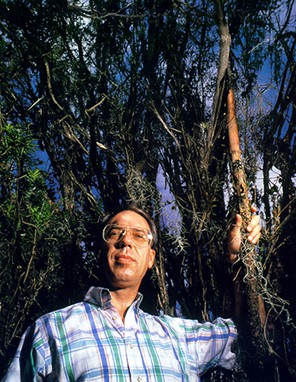 FSU Professor Robert A. Holton’s synthesis of Taxol marked a major breakthrough in the treatment of breast and ovarian cancer. When approved, the National Cancer Institute called Taxol the most important cancer drug developed in the previous 15 years.
According to the National Institutes of Health, more than one million patients have been treated with it.
In the 1960s, researchers at the National Cancer Institute isolated paclitaxel from the bark of the Pacific Yew tree, discovering it inhibited cancer cell division by stabilizing microtubules — a novel mechanism that proved highly effective in chemotherapy.
In 1989, Holton and his team at Florida State University developed a groundbreaking semi-synthetic process to produce Taxol from 10-deacetylbaccatin III, a compound more readily available from renewable sources. This method enabled large-scale production of the drug, leading to its commercialization by Bristol Myers Squibb.
Building on this success, Holton’s team achieved the first total synthesis of Taxol in 1994, marking a significant milestone in organic chemistry. This accomplishment was the result of a highly competitive international race among leading research groups.
The commercialization deal between FSU and Bristol Myers Squibb generated more than $350 million in royalties for FSU, some of which has been used to support the university’s most distinguished scholars.
In 2018, Holton was elected a fellow of the National Academy of Inventors in recognition of his pioneering research.
At the time, Holton said, “I have always been drawn to difficult problems, and synthesizing Taxol was a big one. Seeing the drug’s success in treating so many patients has been an incredibly gratifying experience.”
Holton retired from FSU in 2023 and passed away in 2025.